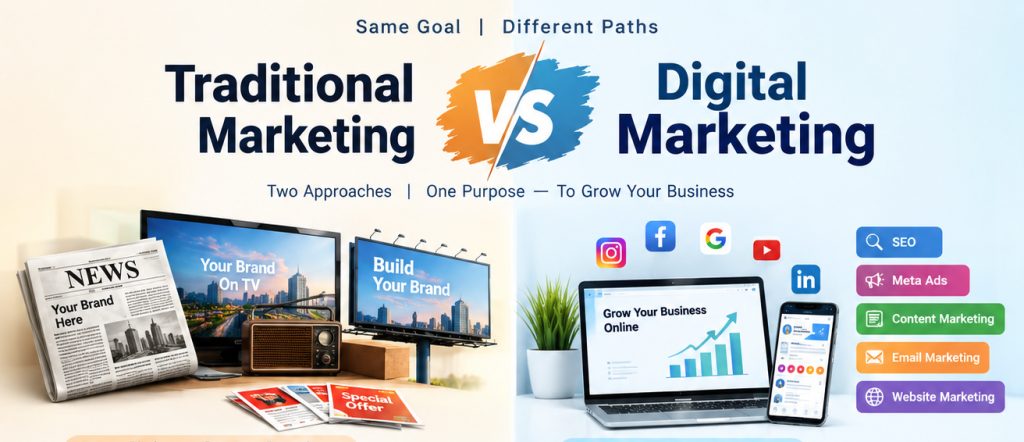
Marketing is essential for every business to attract customers, build brand awareness, and increase sales. Over the years, marketing has changed significantly. Traditional marketing methods such as newspapers, television, radio, and billboards were once the primary ways businesses reached customers. Today, digital marketing has become an important part of how businesses connect with their audiences online.
But what is the difference between traditional marketing and digital marketing? Let’s explore both and understand how they work.
What Is Traditional Marketing?
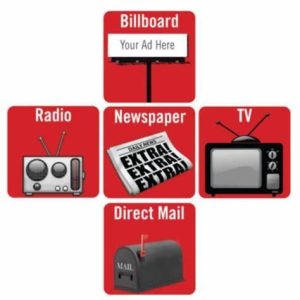
Generally, traditional marketing refers to conventional marketing methods that businesses have used for many years to promote their products or services.
Some common examples include:
- Newspaper and magazine advertisements
- Television commercials
- Radio advertisements
- Billboards and hoardings
- Flyers and brochures
- Direct mail
- Posters
Traditional marketing can be useful for reaching a broad local audience, especially through newspapers, radio, television, and outdoor advertising.
What Is Digital Marketing?
On the other hand, digital marketing involves promoting products, services, or brands through digital channels and online platforms.
Some popular digital marketing methods include:
- Search Engine Optimization (SEO)
- Social media marketing
- Google Ads
- Meta Ads
- Content marketing
- Email marketing
- Website marketing
- Influencer marketing
Digital marketing allows businesses to connect with potential customers through the websites, search engines, social media platforms, and digital channels they use every day.
Traditional Marketing vs Digital Marketing
The biggest difference between traditional and digital marketing is the way businesses reach and communicate with their audience.
| Traditional Marketing | Digital Marketing |
| Uses offline channels | Uses online channels |
| Newspapers, TV, radio, billboards | Google, websites, social media, email |
| Limited audience targeting | Detailed audience targeting |
| Performance tracking can be limited | Results can be measured using analytics |
| Communication is often one-way | Allows two-way interaction |
| Changes can be slower | Campaigns can be updated quickly |
| Often requires higher offline advertising costs | Offers flexible budget options |
1. Audience Reach
Traditional marketing can reach a large audience through television, radio, newspapers, and outdoor advertising. However, it can be difficult to identify exactly who saw or responded to an advertisement.
Digital marketing allows businesses to target specific audiences based on factors such as location, interests, demographics, search behaviour, and online activity.
2. Cost
Traditional advertising can involve significant costs, especially for television advertisements, newspaper placements, billboards, and printed materials.
Digital marketing provides businesses with different budget options. Businesses can start with smaller campaigns and adjust their spending based on performance.
3. Targeting
One of the major advantages of digital marketing is audience targeting.
For example, a local business can create an online advertising campaign specifically for people in Trivandrum who may be interested in its products or services.
Traditional marketing generally provides less precise targeting.
4. Measuring Results
Measuring the results of traditional marketing can sometimes be challenging. A business may know that an advertisement appeared in a newspaper or on television, but determining exactly how many people took action can be difficult.
Digital marketing provides various analytics and tracking tools. Businesses can monitor metrics such as:
- Website traffic
- Click-through rate (CTR)
- Cost per click (CPC)
- Conversion rate
- Leads
- Engagement
- Return on advertising spend (ROAS)
This data can help businesses understand how their campaigns are performing.
5. Customer Interaction
Traditional marketing is generally more one directional. A business delivers a message through an advertisement, billboard, newspaper, or other offline channel.
Digital marketing allows customers to interact directly with businesses through comments, messages, reviews, social media, websites, and email.
This interaction can help businesses understand customer needs and build stronger relationships.
6. Flexibility
Changing a printed brochure, billboard, or newspaper advertisement after publication may not be easy.
Digital campaigns can usually be modified much more quickly. Businesses can update advertisements, change content, adjust targeting, or modify budgets based on campaign performance.
Does Traditional Marketing Still Matter?
Yes. Traditional marketing can still be useful depending on the business, audience, location, and marketing goals.
For example, a local business may benefit from a combination of outdoor advertising, printed materials, social media, Google search visibility, and online advertising.
The right marketing strategy depends on where your target audience spends their time and how they prefer to discover businesses.
Why Businesses Are Moving Towards Digital Marketing
As more people use search engines, websites, social media, and other online platforms to find information and products, businesses have more opportunities to reach potential customers digitally.
Digital marketing can help businesses:
- Increase online visibility
- Reach targeted audiences
- Generate leads
- Build brand awareness
- Engage with customers
- Measure campaign performance
- Improve marketing strategies using data
Traditional Marketing and Digital Marketing Can Work Together
It doesn’t always have to be traditional marketing vs digital marketing.
Businesses can combine both approaches to create an integrated marketing strategy.
For example, a business could promote a new product through a newspaper advertisement while also using Instagram, Google Ads, SEO, and WhatsApp to reach customers online.
The best approach depends on the business’s target audience, budget, goals, and industry.
Final Thoughts
Traditional marketing and digital marketing both have their own purposes and advantages. Traditional marketing can help businesses reach audiences through established offline channels, while digital marketing provides opportunities for targeted communication, online engagement, and measurable campaigns.
For many modern businesses, combining suitable traditional and digital marketing methods can create a broader marketing strategy and help them connect with customers across different channels.
The goal is not simply to choose traditional or digital marketing it is to choose the channels that best match your audience and business objectives.