
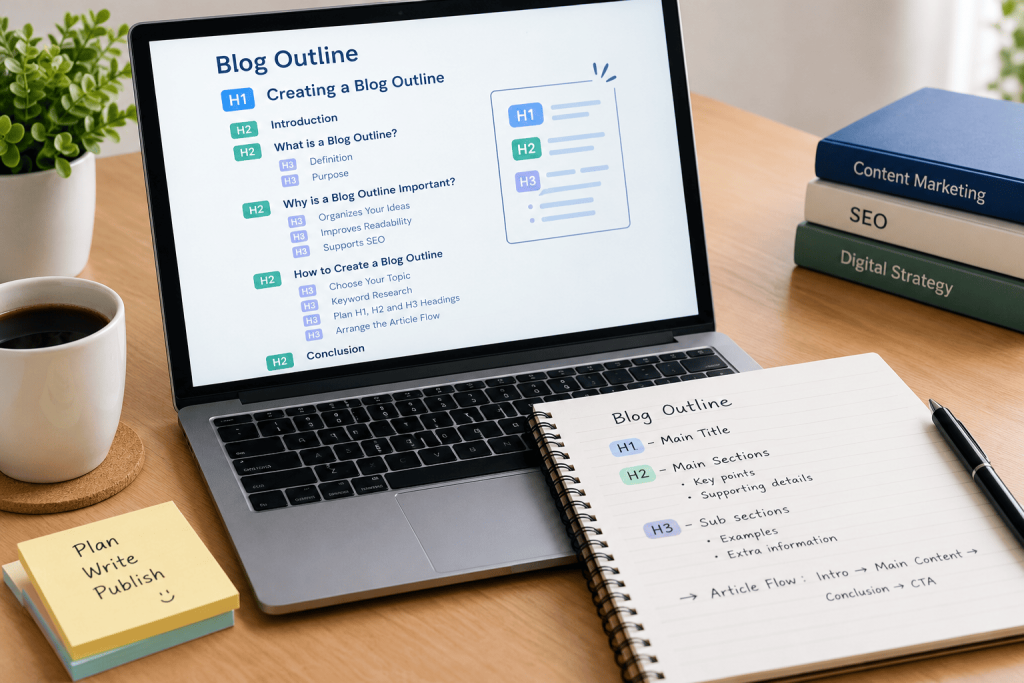
Introduction
Writing a blog post becomes much easier when you have a clear plan. Before you start writing, it is important to organize your ideas and decide what information your article should cover. This process is known as creating a blog outline.
A blog outline acts as a roadmap for your content. It helps you arrange your ideas logically, create meaningful headings, and guide readers from the introduction to the conclusion. Moreover, a well-structured outline can improve readability and help search engines understand your content.
In this article, you will learn how to create a blog outline using H1, H2, and H3 headings and organize your article effectively.
What Is a Blog Outline?
A blog outline is a structured plan that shows how your blog post will be organized. It includes the main topic, important headings, subheadings, and key points you want to explain.
Instead of writing everything at once, you can use an outline to decide what information belongs in each section.
For example, if you are writing a blog about digital marketing, your outline might include the meaning of digital marketing, its different types, its benefits, and tips for beginners.
Therefore, creating an outline helps you stay focused and ensures that your article covers the topic clearly.
Why Is Creating a Blog Outline Important?
A blog outline offers several benefits for content creators and website owners.
1. Organizes Your Ideas
First, an outline helps you arrange your thoughts in a logical order. As a result, readers can understand your content more easily.
2. Improves Readability
Long paragraphs without headings can make an article difficult to read. However, dividing your content into sections makes it easier for readers to scan and find the information they need.
3. Saves Time
Planning your article before writing reduces confusion and unnecessary rewriting. Consequently, you can create content more efficiently.
4. Supports SEO
A clear heading structure helps search engines understand the organization and context of your content. Additionally, relevant headings can help readers identify the sections that answer their questions.
5. Prevents Missing Important Information
An outline allows you to check whether you have covered all the essential points before publishing your article.
Understanding H1, H2, and H3 Headings
Headings are essential elements of a well-organized blog post. Each heading level has a different purpose.
What Is an H1 Heading?
The H1 heading represents the main title or primary topic of your article. It tells readers what the blog post is about.
Example:
H1: How to Start Digital Marketing for Beginners
A blog post generally benefits from one clear, descriptive H1 heading. Your title should communicate the main topic naturally and accurately.
What Is an H2 Heading?
H2 headings divide your article into major sections. Each H2 introduces an important point related to the main topic.
Example:
- What Is Digital Marketing?
- Why Is Digital Marketing Important?
- Types of Digital Marketing
- How to Start Digital Marketing
These headings make the article easier to navigate.
What Is an H3 Heading?
H3 headings provide additional details under an H2 section. They are useful when you need to explain individual points within a larger topic.
Example:
H2: Types of Digital Marketing
- Search Engine Optimization (SEO)
- Social Media Marketing
- Content Marketing
- Email Marketing
In this structure, the H3 headings explain the different types of digital marketing under the main H2 section.
How to Create a Blog Outline Step by Step
Follow these steps to plan a clear and useful blog outline.
1: Choose Your Blog Topic
Start by selecting a topic that matches your website’s purpose and your audience’s interests.
For example, if your website focuses on digital marketing, you could write about SEO, keyword research, social media marketing, or content creation.
Choose a topic that answers a question or solves a problem for your readers.
2: Conduct Keyword Research
Next, identify the keywords people use when searching for information about your topic.
You can use tools such as Google Keyword Planner, Google Trends, or Google Search Console to discover relevant search terms and understand your audience’s interests.
Select a primary keyword and include related terms naturally where they make sense.
3: Understand Search Intent
Before planning your headings, consider what readers actually want to learn.
For instance, someone searching for “how to create a blog outline” probably wants practical steps, examples, and a clear explanation of heading structure.
Understanding search intent helps you create sections that answer the reader’s questions.
4: Write Your H1 Heading
Create a clear and descriptive title that communicates the main topic of your article.
For example:
H1: How to Create a Blog Outline for Better Content Structure
Your H1 should be relevant to the article and understandable to your target audience.
5: Plan Your H2 Headings
Divide the main topic into important sections. Think about the questions readers might ask and the information they need.
For example:
- What Is a Blog Outline?
- Why Is a Blog Outline Important?
- How to Create a Blog Outline
- Common Blog Outlining Mistakes
- Final Thoughts
Arrange the sections in a logical order so that the article flows naturally.
6: Add H3 Subheadings
When an H2 section contains multiple related points, use H3 headings to organize them.
For example, under “How to Create a Blog Outline,” you could include H3 headings for choosing a topic, researching keywords, understanding search intent, and organizing the article.
However, avoid adding unnecessary subheadings when a simple paragraph would be clearer.
7: Plan the Article Flow
Once your headings are ready, check how the sections connect.
A useful blog structure often follows this order:
First, introduce the topic in your introduction and explain why it matters.
Next, explain the main content using clear sections and examples.
After that, provide practical guidance, steps, tips, or solutions.
Then, summarize the key points in your conclusion.
Finally, encourage readers to take a relevant call to action when appropriate.
As a result, readers can follow your article from beginning to end without feeling confused.
8: Review Your Outline Before Writing
Finally, review your outline and make sure every section supports the main topic.
Check whether the headings are clear, the order is logical, and the outline covers the reader’s main questions. Remove repeated ideas and add any missing information before you begin writing.
Example of a Blog Outline
Let’s create a simple outline for a blog about SEO.
H1: What Is SEO and Why Is It Important for Businesses?
H2: Introduction to SEO
H2: What Is Search Engine Optimization?
H2: Why Is SEO Important for Businesses?
- Improves Search Visibility
- Drives Organic Traffic
- Builds Trust and Credibility
H2: Different Types of SEO
- On-Page SEO
- Off-Page SEO
- Technical SEO
H2: How to Improve Your Website’s SEO
H2: Conclusion
This outline provides a clear structure before the full article is written. It also helps the writer identify which topics need further research.
Common Mistakes to Avoid When Creating a Blog Outline
Although outlining is simple, some mistakes can affect the quality of your content.
Always choose descriptive headings that clearly communicate what each section covers.
Additionally, make sure every section adds something useful to your content.
Always plan your content around what your audience actually wants to know.
Instead, select heading levels according to content hierarchy, not appearance alone.
Moreover, keep the structure simple and relevant without adding unnecessary subheadings.
Finally, arrange your sections so each idea leads naturally to the next.
Avoiding these mistakes will help you create a more organized and reader-friendly blog post.
Conclusion
Creating a blog outline is an important step in effective content writing. By planning your H1, H2, and H3 headings, you can organize your ideas, improve readability, and make sure your article covers the topic clearly.
Moreover, combining keyword research with search intent and a logical article flow helps you create content that is useful to readers and easier for search engines to understand.
Before writing your next blog post, take a few minutes to prepare an outline. A clear plan can make the entire writing process more focused, efficient, and effective.
Want to improve your website’s search visibility? Explore Neena Digital for digital marketing, website design, and SEO insights that can help your business grow online.