
Keywords play an important role in Search Engine Optimization (SEO). They help search engines understand your website content and connect it with people searching for relevant information, products, or services.
However, not all search terms are the same. Some are broad and general, while others are more specific and detailed. These are commonly known as short-tail and long-tail keywords.
Understanding their differences can help you create relevant content, attract the right audience, and improve your website’s search visibility.
What Are Short Tail Keywords?
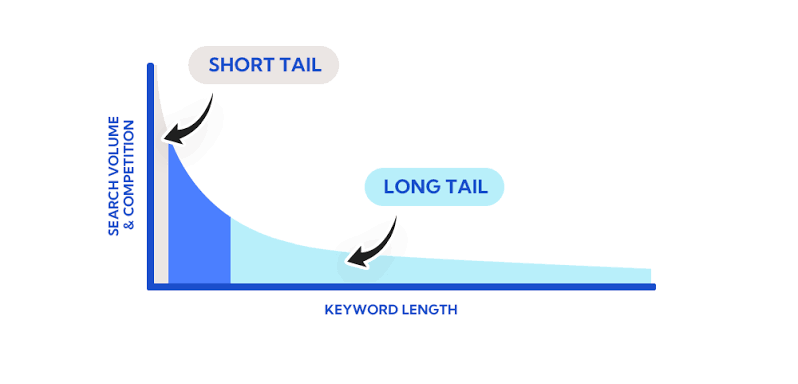
Short-tail keywords are broad search terms that usually contain one or two words. They cover general topics and often attract a high volume of searches.
For example:
- Digital marketing
- SEO
- Website design
- Social media marketing
- Online business
These terms can help websites reach a wider audience. However, they are often highly competitive because many websites target the same phrases.
Moreover, the search intent behind a broad term may not be clear. For instance, someone searching for “SEO” might want to learn its meaning, find an SEO service, or discover useful tools.
When Should You Use Short Tail Keywords?
These keywords are useful when:
- You want to build awareness around a broad topic.
- You are creating main service pages or category pages.
- You want to target a wider audience.
- You are developing a long-term SEO strategy.
Nevertheless, ranking for these terms can be challenging, especially for new websites.
What Are Long Tail Keywords?
Long-tail keywords are more specific search phrases that usually contain three or more words. They target a particular need, question, location, or service.
For example:
- Digital marketing services for small businesses
- How to improve website SEO
- Affordable website design in Trivandrum
- How to get more customers online
- Best SEO strategies for beginners
Compared with broader search terms, these phrases often have lower search volumes. Nevertheless, they can attract visitors who have a clearer idea of what they need.
For example, a person searching for “website design” may simply be exploring options. In contrast, someone searching for “affordable website design in Trivandrum” may be looking for a local service provider.
When Should You Use Long Tail Keywords?
These specific phrases are especially useful when:
- You want to target a particular audience.
- You are writing blog posts that answer specific questions.
- You want to attract relevant website visitors.
- You are targeting local customers.
- You want to address specific customer needs or services.
Therefore, they can be a practical starting point for new websites and small businesses.
Short-Tail vs. Long-Tail Keywords: Key Differences
The following table highlights the main differences between these two keyword types.
| Feature | Short-Tail Keywords | Long-Tail Keywords |
| Length | Usually 1–2 words | Usually 3 or more words |
| Search volume | Often high | Often lower |
| Competition | Usually high | Often lower |
| Search intent | Broad or unclear | More specific |
| Audience | Wider audience | More targeted audience |
| Conversion potential | Varies | Can be higher for specific needs |
| Best use | Broad topics and main pages | Blog posts, specific services, and local searches |
Keep in mind that these are general patterns. Some specific search phrases can be highly competitive, while certain broad terms may have clear search intent.
Which Keywords Are Better for SEO?
Both keyword types are valuable. The right choice depends on your website’s goals, target audience, and competition.
If your website is new, targeting highly competitive terms alone may make it difficult to gain visibility. Instead, start by identifying relevant phrases that match your audience’s needs.
For example, if you offer digital marketing services, you could target terms such as:
- Digital marketing services for small businesses
- SEO services in Trivandrum
- WordPress website designer in Trivandrum
- How SEO helps small businesses grow
As your website gains relevant content and authority, you can also target broader search terms that align with your services.
Ultimately, a balanced keyword strategy is more effective than focusing on only one type.
How to Use Both Keyword Types Together
To build an effective SEO strategy, follow these steps.
1. Research Your Keywords
Use keyword research tools such as Google Keyword Planner, Google Search Console, or other SEO tools to discover relevant search terms. Consider search volume, competition, and the intent behind each phrase.
2. Understand Search Intent
Next, identify what users want when they search for a particular term. Are they looking for information, comparing services, or ready to make a purchase?
Choose phrases that match the purpose of each page.
3. Assign Keywords to Relevant Pages
Use broad terms naturally on relevant main pages, service pages, or category pages. Meanwhile, use more specific phrases to guide blog topics, FAQs, and detailed service pages.
4. Create Helpful Content
Write content that answers your audience’s questions clearly. Include your target phrase naturally in the title, headings, introduction, and body where appropriate.
Avoid keyword stuffing because it can make content difficult to read. Consequently, it does not guarantee better rankings.
5. Monitor and Improve Performance
Finally, use Google Search Console to understand which queries bring visitors to your website. Review impressions, clicks, click-through rates, and ranking positions.
Based on this information, improve existing content and identify new opportunities to reach your target audience.
Common Mistakes to Avoid
When developing your keyword strategy, avoid these common SEO mistakes:
- Targeting only high volume search terms.
- Ignoring search intent.
- Choosing phrases that are unrelated to your content.
- Repeating the same keyword unnaturally.
- Creating separate pages for very similar queries without a clear purpose.
- Expecting specific search phrases to guarantee quick rankings.
Instead, focus on useful content, relevant search terms, and a positive user experience.
Conclusion
Short-tail and long-tail keywords serve different purposes in SEO. Broad terms help you target wider audiences, whereas more specific phrases allow you to address particular questions and customer needs.
For the best results, combine both types in your keyword strategy. Start with relevant, specific phrases, create helpful content, and gradually expand your keyword coverage based on performance.
Ultimately, by understanding what your audience searches for, you can improve your website’s visibility and attract more relevant visitors over time.
Want to improve your website’s search visibility? Explore Neena Digital for digital marketing, website design, and SEO insights that can help your business grow online.